


City Council Hearing on Horse Carriage Ban is “Kangaroo Court”
Though the industry has long been the target of special interest groups and some lawmakers, the bill gained more traction when it was renamed after Romanch Mahajan, the 18-year-old tourist who was killed in a heartbreaking carriage accident last month in Central Park.
Some of the groups, like NYCLASS, have for years made the case that cruelty to animals was the objection to the industry—a claim that has never been proven—and have recently taken up the cause of the Mahajan family.
An alternate bill providing increased safeguards and enforcement of the industry is sponsored by Council Member James Gennaro, but has not been scheduled.
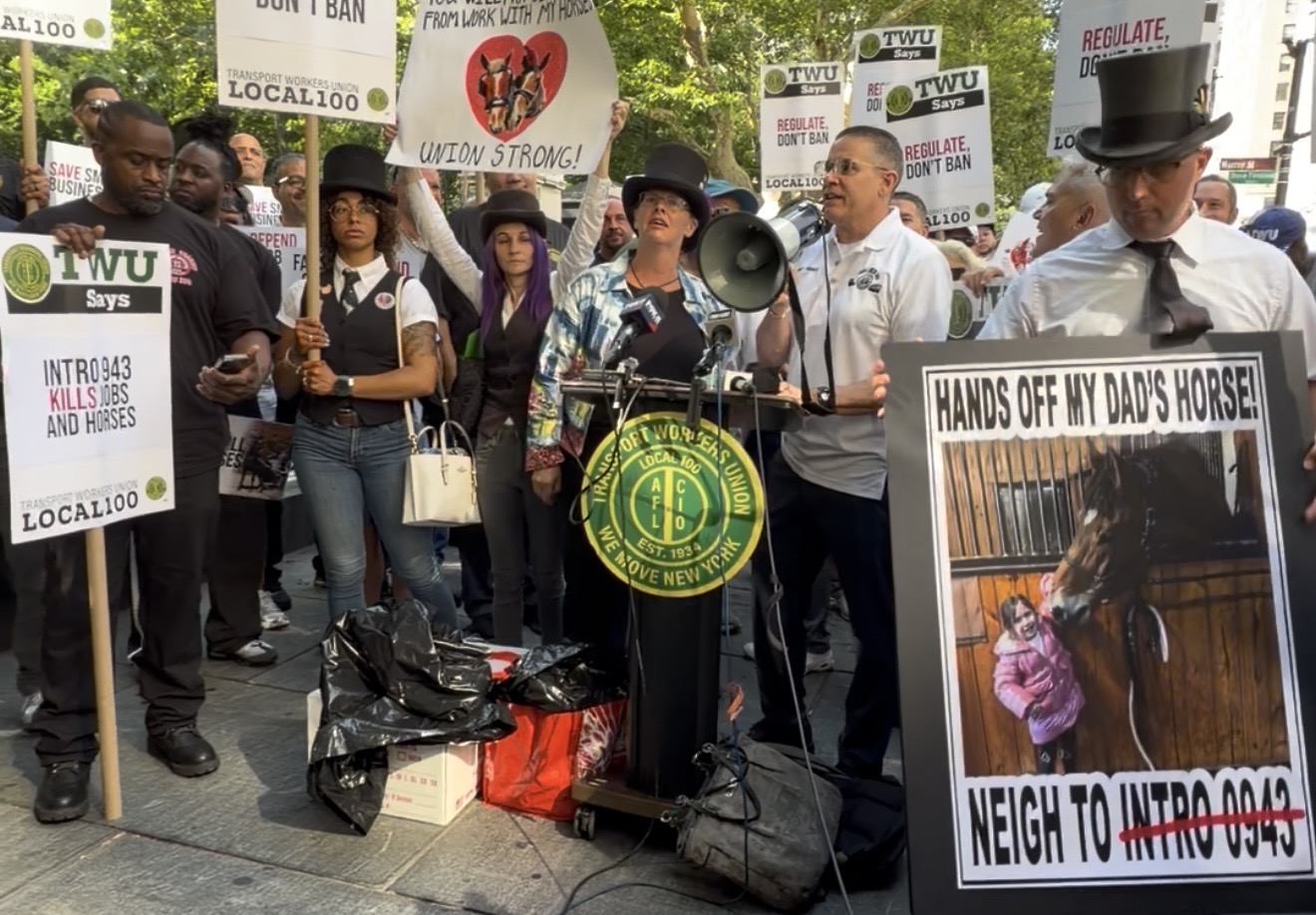
Several panels were convened by those opposed to the bill, with TWU Local 100 President John V. Chiarello, Administrative Vice President Alexander Kemp, carriage drivers, stable owners, equine experts and veterinarians taking turns to testify, but three hours into the hearing none of those voices had been heard.
Many City Council Members who attended left the chambers by the time anyone in support of the carriage horse industry had spoken.
The City Council’s own X feed had 11 posts in a row in support of a bill that would put over 150 hard-working people, many of them immigrants, out of a job.
“What about my members’ American Dream?” asked Chiarello of the members of the Council who were present when it was his turn to speak. “I’ve asked the City Council to table this and also take up Councilman Gennaro’s offer to find a safer place in Central Park.”
The horses who work in the industry would also face uncertain futures—animal activists claim all the horses would be relocated to sanctuaries, but as equine veterinarian Dr. Gabriel Cook testified, animal sanctuaries are sadly overextended and many are unable to shoulder the prohibitive cost of caring for horses.
Sadly, not as many members of the Council heard that important point because they had already left, but they heard testimony from PETA and NYCLASS in the first panel.
The founder of NYCLASS is Steve Nislick, a developer who has been agitating for years to end the industry and has expressed interest in developing Manhattan’s west side, where the stables are located.
“I’m the longest serving active Council Member. This is not how the council is supposed to work,” said Councilman Gennaro.
Under repeated questioning about internal union housekeeping issues, Chiarello asked why the points were relevant.
“The benefits of being in a union is what I’m doing right now and advocating for them,” said Chiarello, to approval from the crowd.
Many drivers addressed the absurd notion that they should part with their beloved animals and go to work in the hospitality industry, as Council Speaker Julie Menin has suggested.
“I own a horse, his name is Sherman,” said Christina Hansen, carriage driver and Chief Shop Steward. “This bill is telling me that I can’t go to work with my horse..I don’t need to be told to go work in a hotel, I’m a horse person,”
As fewer and fewer legislators remained in the chambers, it was noted that the die had already been cast.
“I cannot begin to express our disappointment with this legislative process,” said Sharase DeBouse, TWU Local 100’s Political Director. “Public hearings should exist to inform legislative decisions, not simply ratify the decision that has already been made by a kangaroo court.”
Council Members were reminded that it was in fact the job of the city to oversee the carriage horse industry in Central Park, something that has been overlooked.
“I demand that prior to making a decision on this industry you look at all the responsibilities that you have to uphold your end of the bargain and then correct them and see what the future looks like,” Kemp testified.
We know a safer future is necessary, and Local 100 supports a bill that mandates tougher training and periodic retraining, hitching posts in the park, enforcement from the Department of Health and increased safety protocols.
Today’s process did not show a willingness from the City Council to partner with the hundreds of workers who would be irrevocably affected by the passage of Intro. 943. It showed something else: a democratic process all but hijacked by monied elites, Central Park Conservancy board members, real estate developers and misguided animal rights activists.