
Horsepower
| Intro | | | Giving Back | | | Horse Care | | | What Vets Say | | | Union Support |
|
Feature: |
Transport Workers Union Local 100 represents the Central Park horse-carriage drivers and owners who provide one of the most popular outdoor attractions in NYC.E-Bike Accidents and Deaths are Rampant But Horse-Carriages Wrongly Targeted |
 |
|
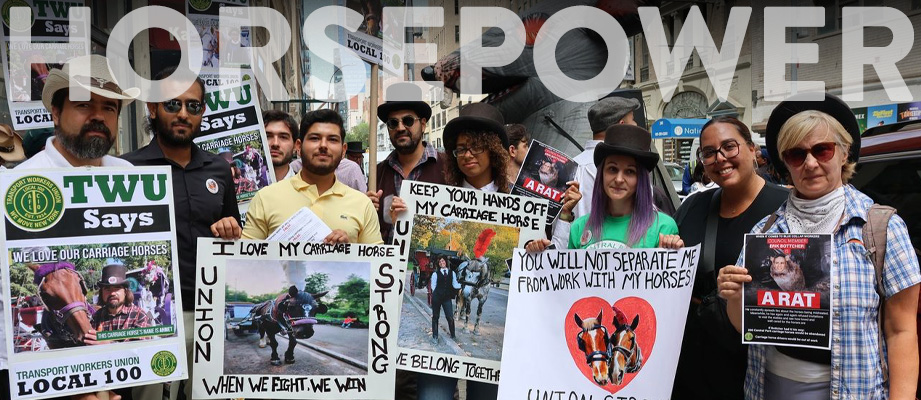
Intro 943: No Real Protections for Carriage Drivers, Owners, or HorsesCity Council Speaker Julie Menin has fast-tracked Intro. 943, a bill to ban horse-drawn carriage rides, claiming that it has been improved with amendments to take care of workers who will be stripped of their livelihoods. A vote is scheduled for Thursday, Oct. 22. Despite Menin’s promises, the truth remains that hundreds of horse carriage drivers, owners, and their family members will callously be kicked to the curb to fend for themselves. The bill is farce. There is no concrete plan providing economic relief, no funding, no safeguards to ensure horses won’t wind up in the glue factory once evicted from their stables. All Councilmembers of good conscience should take a stand against this abomination. It’s many flaws include: Read More» Horses Lives Will Be in Jeopardy. Some Will Die.In April, law enforcement seized and removed 69 horses from the Happy Valley Horse Rescue in Ocala, Florida, that were severely malnourished, emaciated, and in pain due to a lack of proper medical care. Two were beyond recovery and had to be euthanized. In May, authorities removed 165 horses from the Villa Chardonay animal rescue and shelter in San Diego, California, because the horses were suffering from “severe neglect.” The horses were emaciated, and some were essentially crippled because they didn’t receive proper care for their hooves, which became cracked and infected. Supporters of the proposed carriage-horse ban (Intro 943) have given the NYC Council and the public false information, saying it will be easy to find new homes for the 180 carriage horses. The reality is this: there is a national crisis of too many horses and too-few good homes for them. Sanctuaries and rescues are largely unregulated and rely on donations. They constantly struggle financially and can’t take in more horses. Read More» Forced Closure of Small Businesses, American Dreams DestroyedNew York City lost thousands of small businesses last year. Unable to pay their rent, staff, and taxes, they closed-up shop. Intro. 943 would throw fuel on the fire. The bill, which would ban horse-carriage rides, would force 68 mom-and-pop small business in the tourism industry to shut down. Horse-Carriage owners would be stripped of their city-owned medallions and about 150 active drivers would be unemployed. Read More» There are approximately 170 licensed carriage drivers and owners operating out of three privately-owned stables on the West Side of Manhattan. They provide hundreds of thousands of rides annually to tourists from around the world, along with New York area residents who are celebrating momentous occasions like weddings and anniversaries, are enjoying a night on the town, or are having a relaxing family day in the 843-acre park. The carriage drivers and owners also hail from around the world. A vast majority of them are immigrants or children of immigrants who came in search of the American dream. Carriage people are horse people who choose to work with these majestic animals over other possible careers. They raise their kids, save for college, pay their rent, and make their mortgage payments working in the horse-carriage trade. Carriage rides have been a feature of Central Park since the first section opened to the public in 1858. Today, carriage rides are provided in compliance with extensive regulations enacted by New York City government. Oversight and enforcement are carried out by five city agencies, including the New York City Department of Health and Mental Hygiene and the New York Police Department. The carriage horses get physical exams by equine veterinarians 2 to 4 times a year, regular dental care, vaccinations, regular hoof trimmings, new shoes every eight weeks or sooner, comfortable stalls that are cleaned throughout the day – and a minimum of five weeks of vacation (many spend several months on farms). They have short walking commutes between their stables and the park, and they spend very little time on the streets. “After much investigation, it was clear to me these horses are living happy lives with owners who truly care for their well-being,” Dr. Mark Jordan, an equine veterinarian, wrote in an essay published in the New York Daily News . “These owners/drivers are proud of their animals and provide them with excellent care on a daily basis. I strongly support the continuation of these carriage horses in New York City as an equine veterinarian, long-time horse owner and horseman.” |
 |
Crushing Workers American Dreams How am I Going to Pay My Bills?
|
